
This post has been first posted on LinkedIn by Amir Khamidullin and the New World Investment Research page on September 1, 2026. LinkedIn News featured this post in “Ongoing bond slide could ‘squeeze’ consumers globally” news coverage on September 3, 2026.
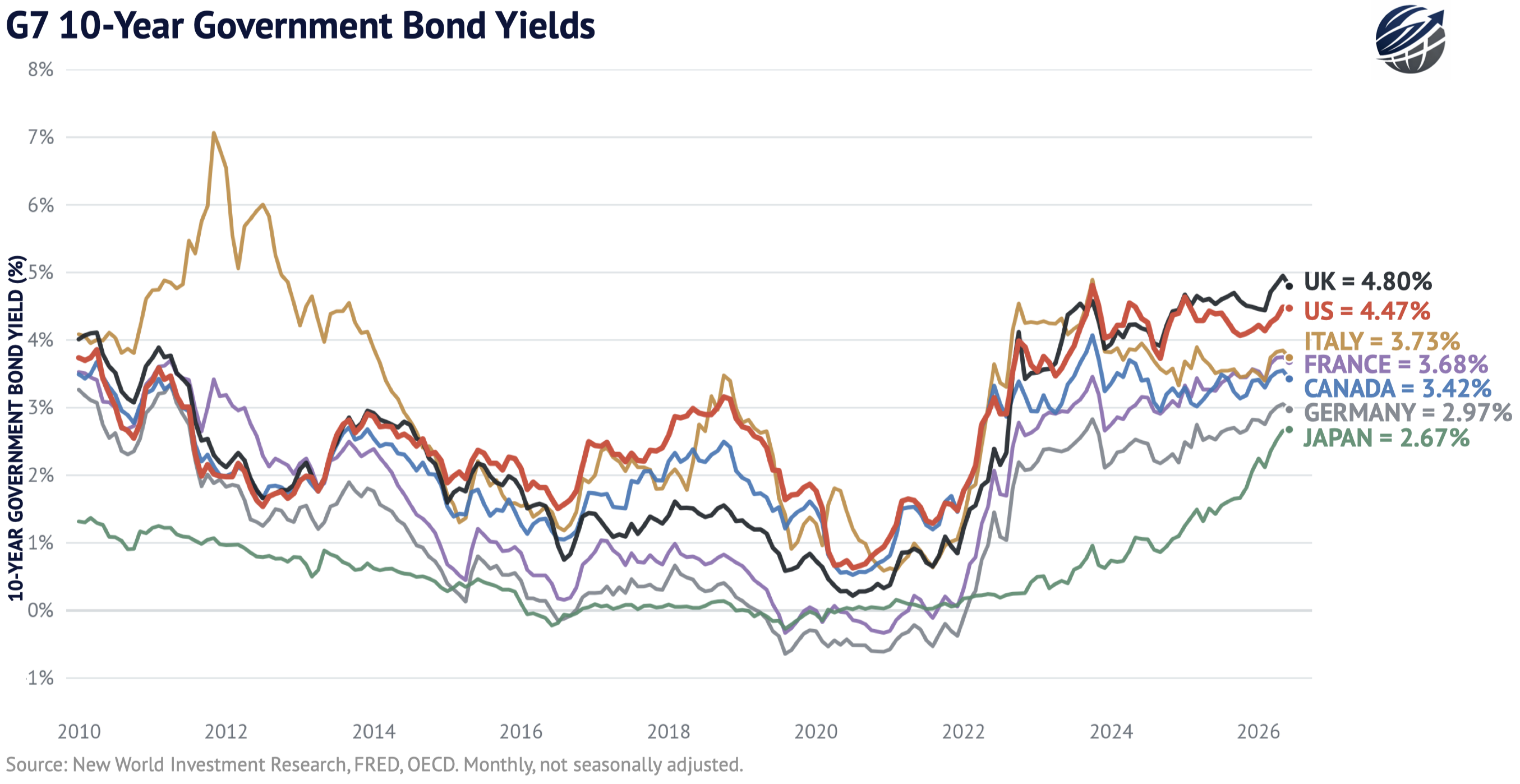
The 10-year Treasury yield has risen to around 4.5%. But this is not uniquely American: UK yields are even higher, while borrowing costs have increased across much of the G7. That points to a broader repricing of inflation, interest rates, and duration risk, not simply a flight from US debt.

The currency signal is equally important. The dollar has strengthened on a trade-weighted basis in 2026. A genuine credibility crisis would usually produce the opposite combination: rising yields alongside a falling currency, weakening auctions, and capital outflows.
Still, the CBO projects publicly held US debt to rise from approximately 101% of GDP in 2026 to 120% by 2036. As debt supply and interest costs increase, investors may demand a larger premium to hold long-dated Treasuries.
At the same time, hyperscalers and other large technology companies are expected to issue more debt to finance the enormous capital expenditure required for AI infrastructure, data centers, energy, and computing capacity. These highly rated companies can offer investors an increasingly attractive alternative to Treasuries. Although their issuance remains small relative to the US government’s borrowing needs, it adds to the overall supply of long-duration debt and intensifies competition for the same pool of global capital.
The bottom line is that the market is not questioning whether the US can repay its debt, but rather asks whether the US should continue to borrow at exceptionally favorable rates simply because Treasuries have historically been treated as the unquestioned global safe asset.
The privilege of borrowing cheaply, at an enormous scale and without question, is becoming less automatic.
By Amir Kh.
Leave a Reply