
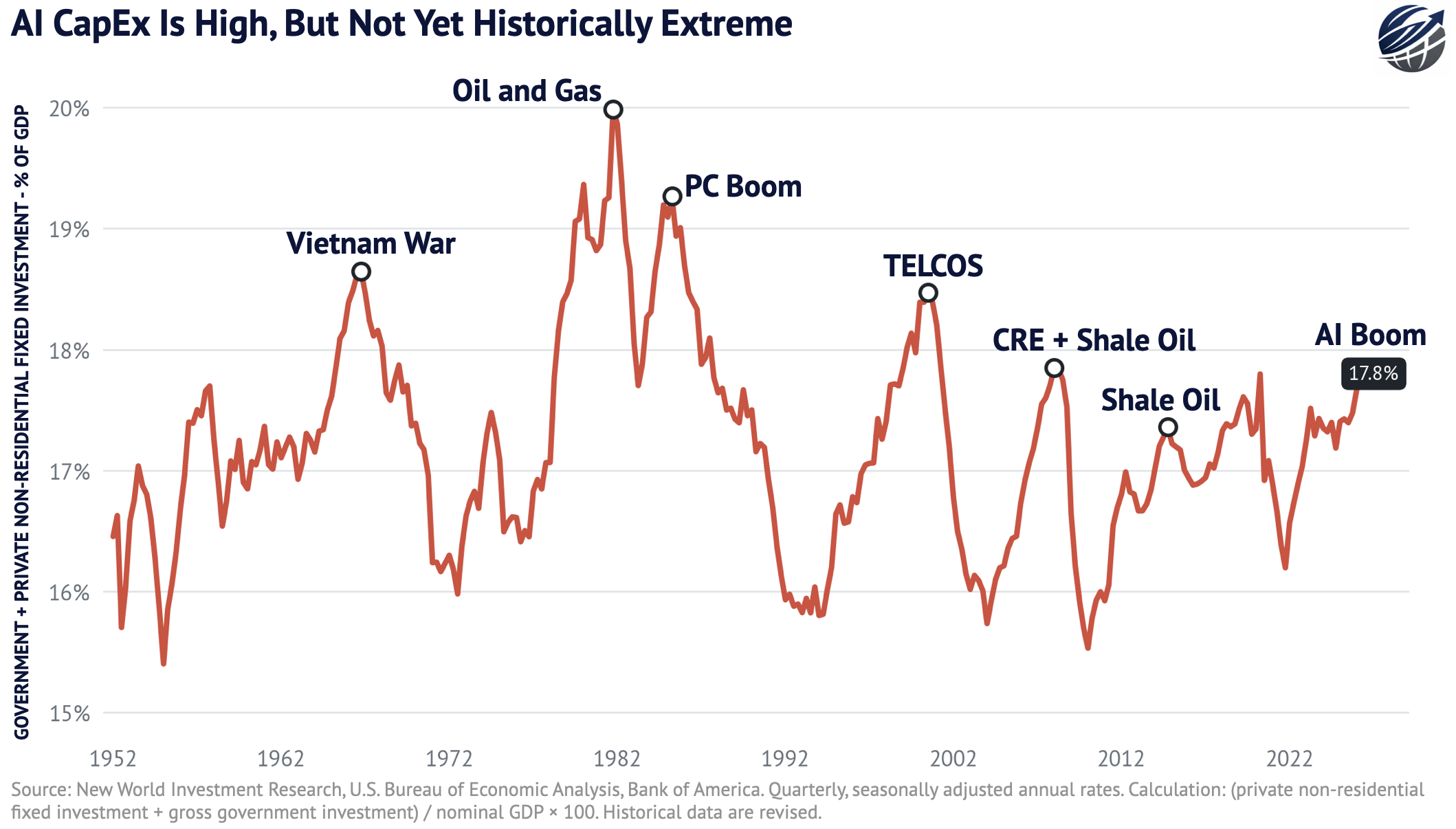
AI investment may be unusually high without being historically abnormal.
However, that comparison addresses only the macroeconomic question: can the economy sustain this level of capital formation?

It does not answer the more important investment question: will the capital earn an adequate return?
The distinction matters because this cycle has three unusual characteristics:
1) AI spending is accelerating from an already high base of business investment. The risk is therefore not necessarily an economy-wide excess of capital, but a concentrated and simultaneous commitment to similar assumptions about demand, pricing, and adoption.
2) The assets being built have demanding economics. Servers and accelerators require large upfront investment, consume substantial power, and can depreciate quickly as newer hardware becomes more efficient. Returns depend not simply on constructing capacity, but on achieving high utilization before the underlying technology becomes obsolete.
3) Technological value and investor value are not the same. Infrastructure booms can transform an economy while producing weak returns for those who financed them. Railways, telecom networks, and internet infrastructure created enormous productivity gains, but competition and overbuilding transferred much of the benefit to users through lower prices.
AI may produce a similar outcome. More computing capacity could reduce inference costs and accelerate adoption, creating substantial value for businesses and consumers. Yet those same forces could commoditize capacity and compress returns for infrastructure owners.
The central risk, therefore, is not that AI demand disappears. It is that supply expands faster than profitable demand, and that the cost of delivering each new unit of computing remains higher than the revenue it generates.
This makes the aggregate investment-to-GDP ratio a poor measure of whether AI is overinvested. The more relevant indicators are utilization, depreciation, pricing, cash returns, and the speed at which customers convert AI usage into measurable economic value.
It also changes where investors should look. Returns are more likely to accrue where scarcity creates durable pricing power: reliable electricity, grid connections, cooling, water access, specialized equipment, and permitted locations. They are less certain where capital can replicate capacity and competition can erode margins.
The bottom line is that the most plausible risk is not whether the AI buildout stops, but that the buildout succeeds technologically while disappointing financially.
By Amir Kh.
Leave a Reply