
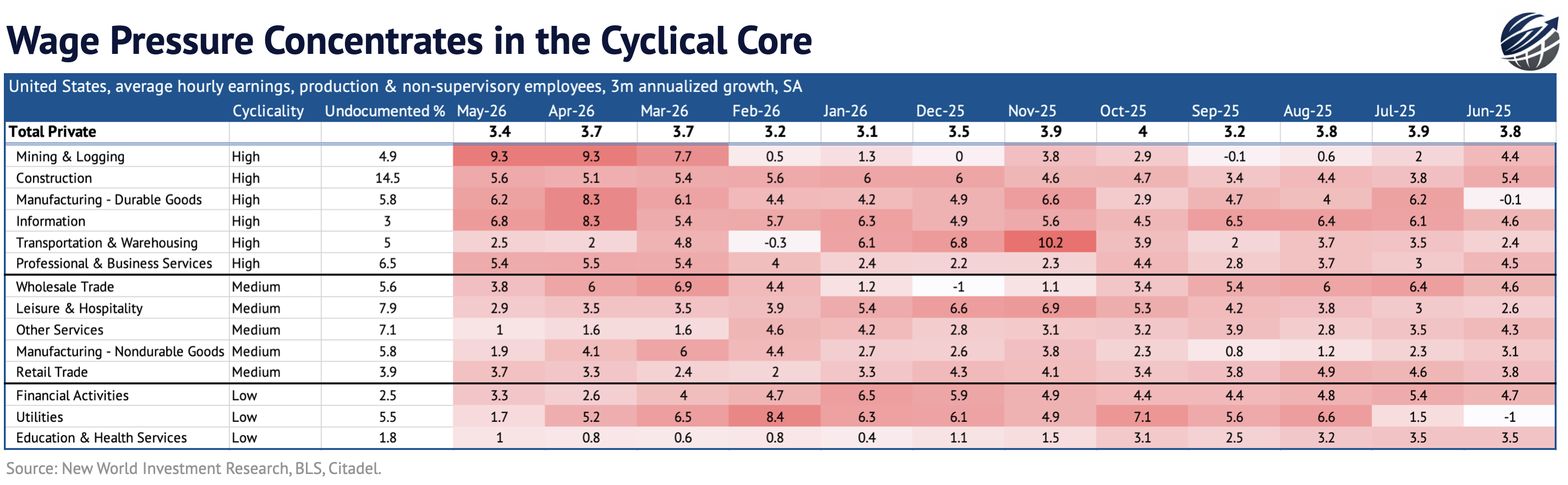
Wages are accelerating fastest in exactly the sectors most exposed to the business cycle.
The textbook analysis of the greater demand for labour would predict rising wages as firms are increasingly competing for a limited number of labourers. This is indeed captured by the average hourly earnings (AHE) statistics, with highly cyclical industries seeing the greatest 3-month annualized growth. The interpretation here is two-fold. On one side, it can be argued that inflation expectations, stemming from the ongoing energy crisis, easy financial conditions, capex boom, and supply chain bottlenecks, are spilling over to more cyclical parts of the economy, meaning that wages there are growing faster than in other parts of the economy. On the other side, it should be seen as the leading indicator of the broader economic expansion coming from historically high AI-linked capital expenditure and positive output gap. For now, it seems that the former side is outweighing the latter as higher energy prices and supply chain disruptions are putting additional upward pressure on wages and prices, a dynamic worth watching closely.

Yet, a rise in AHE among cyclical industries provides another sign of potential sustained labour market recovery.
Therefore, the essential determinant of labour market health is whether current gains are short-term or long-run in nature and thus whether the US economy will be able to provide a lasting, persistent, and structural demand for labour.
By Amir Kh.
Leave a Reply