
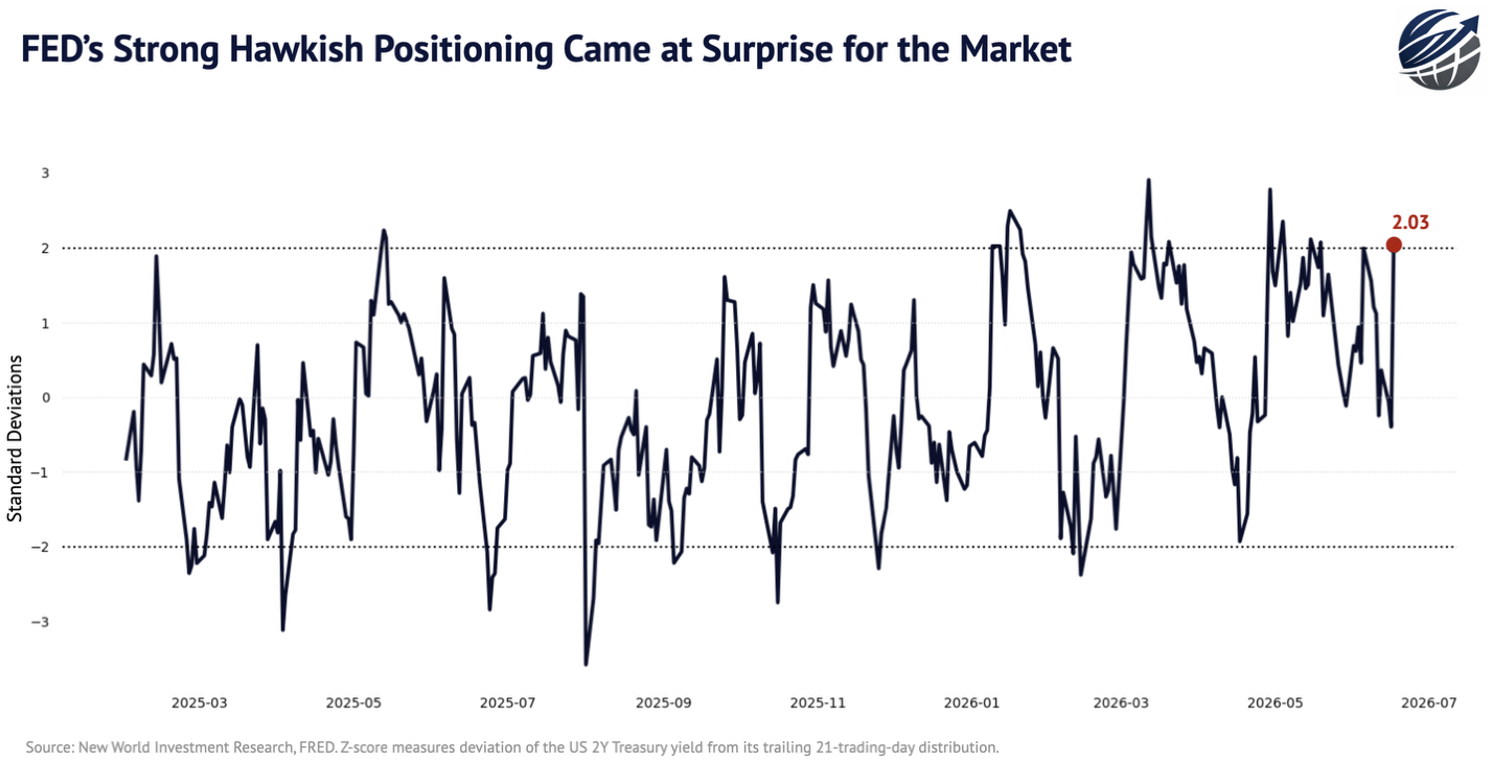
The Fed decided to put rates on hold during its most recent meeting on June 17, with the target range for the federal funds rate (FFR) remaining at 3.5% – 3.75%. Federal Reserve projects median PCE inflation to slow down from 3.6% this year to 2.3% in 2027, while median core PCE drops from 3.3% to 2.5%. The growth in real GDP, according to policymakers, is estimated to be 2.3% in the next year compared to 2.2% projection for 2026.

While it was expected from the new Fed chairman, Kevin Warsh, to hold rates steady and move communication towards a hawkish bias, the market reaction highlights that the current positioning of the Federal Open Market Committee (FOMC) came as a surprise, with yields on 2Y Treasuries (which are most sensitive to inflation and changes in FFR) moving 2 standard deviations upwards (Figure 1). Such an upswing in terms of z-score is not unusual, given the volatile energy prices, yet the immediate reaction of the market to FOMC’s release was a climb by roughly 16 basis points to around 4.19% in 2Y yields.
The bottom line is that the market was expecting a softer hawkish communication on the monetary policy.
By Amir Kh.
Leave a Reply