
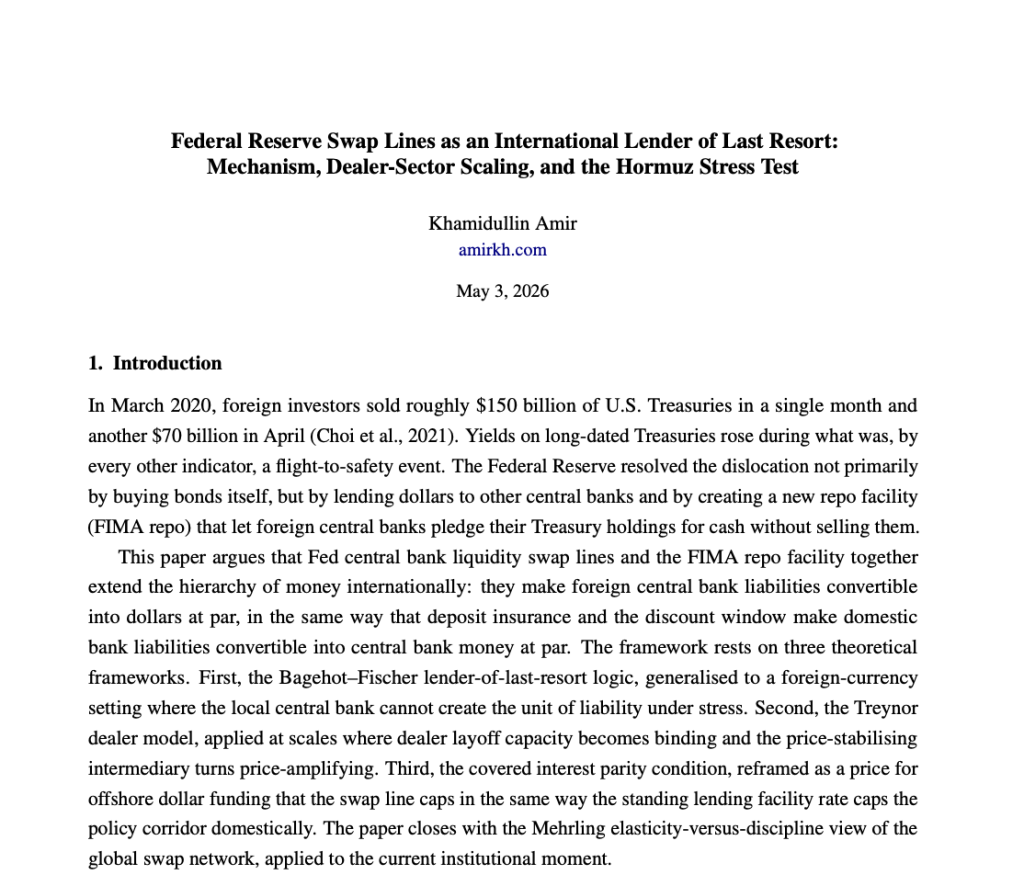
Recently I finished a paper on “Federal Reserve Swap Lines as an International Lender of Last Resort: Mechanism, Dealer-Sector Scaling, and the Hormuz Stress Test,” which is particularly relevant given the ongoing tensions in the Middle East and energy market backdrop.
This paper argues that Federal Reserve central bank liquidity swap lines and the FIMA repo facility together extend the hierarchy of money internationally, making foreign central bank liabilities convertible into U.S. dollars at par in the same way the discount window does domestically. The paper develops three connections to standard money and banking theory. First, the cross-currency basis is reframed from a no-arbitrage condition into a market price for offshore dollar liquidity, with the swap-line rate at OIS plus 25 basis points acting as a corridor ceiling analogous to the standing lending facility rate in the domestic policy corridor. Second, the Treynor dealer model is shown to break at scale: in March 2020, foreign official Treasury sales of approximately $150 billion in a single month overwhelmed dealer balance-sheet capacity, and swap lines and FIMA repo are reinterpreted as supply-side instruments that reduce the inventory the dealer sector must absorb. Third, the architecture is applied to the current Hormuz stress configuration, where sustained energy prices compress surpluses across major Treasury-holding economies simultaneously and differential access to Fed facilities determines which countries can avoid forced Treasury liquidation. The paper concludes with Mehrling’s (2015) elasticity-discipline framing applied to the Powell leadership transition, arguing that institutional credibility is the binding variable in the next stress event.
Read the full paper as a PDF below:
By Amir Khamidullin
New World Investment Research
 New World Investment Research
Leave a comment