
Our research poster for the NYU Shanghai Spring 2026 Undergraduate Research Symposium, co-authored with Qiwen Zheng and mentored by a professor from NYUSH faculty, is ready.
It explores an interesting puzzle: the Fed was tightening aggressively while the PBOC was cutting rates. Standard theory says tight money suppresses investment and cheap credit stimulates it, but neither prediction held.
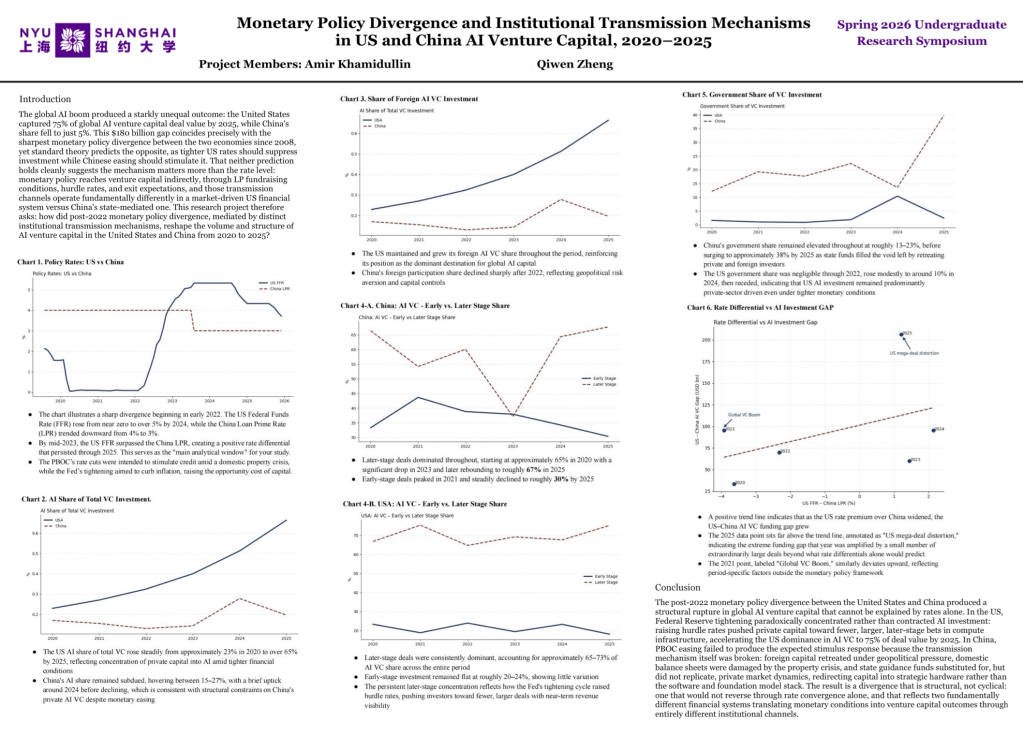
Our argument is that transmission mechanisms explain what rate levels cannot. In the US, higher rates concentrated private capital into compute infrastructure mega-deals: fewer bets, larger sizes, and later stages. In China, easing couldn’t transmit into private AI VC because the channel itself was broken: foreign capital retreated post-2022, the property crisis damaged domestic balance sheets, and state guidance funds redirected capital into strategic hardware rather than the software stack US investors were backing.
In other words, there is the same global AI boom, but two completely different financial systems with two completely different outcomes, which indicates a structural divergence.
#ai #monetarypolidy #fed #pboc #nyu #vc
—
Follow for more research & insights at amirkh.com
 New World Investment Research
Leave a comment