
Bloomberg data show that China is increasingly exporting capital while the US is concentrating on attracting investment at home. As US policy focuses on reshoring production through tariffs, subsidies, and investment incentives, Chinese firms are expanding overseas investment funded largely by China’s growing trade surplus.
In the first half of 2025, Chinese outbound investment exceeded that of the US and accounted for about 10% of total global outflows, according to OECD data cited by Bloomberg. Over the same period, the US absorbed roughly 20% of global inbound investment. Announced Chinese outbound investment in greenfield projects such as factories, data centers, and industrial facilities reached a record level in 2025 and is expected to increase further, based on estimates from Rhodium Group reported by Bloomberg.
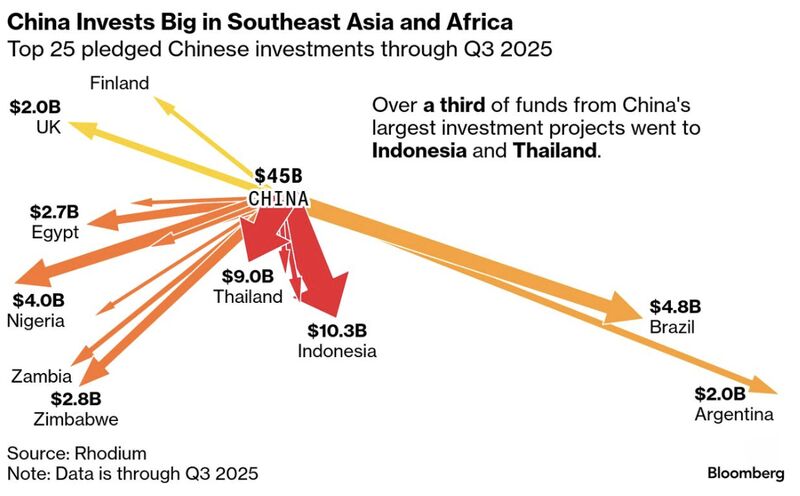
This trend has economic and geopolitical implications. Chinese outward investment increases China’s role as a provider of capital and employment in host economies, changing its position from primarily a trade partner to a direct investor. This creates longer-term economic linkages than trade flows alone.
The pattern is particularly relevant for Latin America. Bloomberg reporting indicates that China is unlikely to reduce its investment presence in the region despite renewed US efforts to attract capital domestically. For countries such as Brazil, continued Chinese outward investment provides an alternative source of capital and reduces reliance on a single external partner.
Overall, Bloomberg data suggest that while the US is prioritizing inward capital flows, China is expanding its role in global outbound investment, with implications for capital allocation and economic influence across regions
#china
 New World Invesment Research
Leave a comment