
Why does China have low household consumption?
One of the key challenges facing China today is weak domestic demand. Household consumption in China as a percentage of GDP has been lagging behind other upper-middle-income countries for decades, with an average value of 48 percent in 2023, well above China’s 40 percent.
There are three key reasons for structurally low domestic demand in the world’s second-largest economy in the past 25 years. First, due to liberalization of labor markets, workers started to migrate from rural to urban areas. In 1982, only about 7 million rural residents worked outside their home counties, but by 2012, that figure had risen dramatically to around 163 million. As the supply of labor increased, growth in wage levels compressed, which resulted in lower growth of disposable income despite massive economic growth. This factor alone would’ve contributed to lower consumption levels, assuming that the saving ratio is fixed.
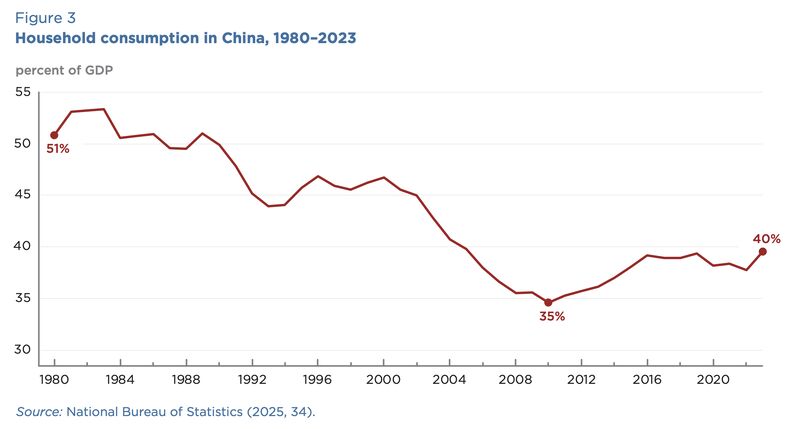
Next, as industrial restructuring occurred in the 1990s, tens of millions of employees in state-owned enterprises were laid off, losing both their jobs and the pension benefits they had expected, which encouraged precautionary savings across China amid uncertainty. Later, in 2002, extremely low and even negative real interest rates on deposits prompted even more savings by households. This is because consumers save not just to get a higher return but rather to save to reach a specific future goal (a down payment on housing, a precautionary buffer for medical shocks, education, retirement, etc.). Thus, to achieve a predetermined level of savings, one should save even more with lower rates. This is precisely what happened with households in China.
Now, as the working-age population decreases in China and the economy continues to expand, wages are expected to rise, so are disposable incomes. This is because labor is derived demand, demand for goods and services. Also, China recently announced $9 billion in consumer subsidies targeted at spurring domestic household consumption.
Taken together, the rising wage share of national income and government expansion of the social safety net should bring China’s level of household consumption as a percentage of GDP to higher levels over time.
***
Chart source: Peterson Institute for International Economics.
 New World Investment Research
Leave a comment